Economy
Smart move. Bangladesh turns to loans in yen to ease repayment pressure


In a move to manage risks associated with rising interest rates and a volatile US dollar, the government has decided to take some loans from the development partners in Japanese yen instead of dollars.
The yen loans are being taken particularly for scale-up window loans from the World Bank at market-based interest rates, according to officials at the Economic Relations Division (ERD).
Budget support of $300 million and an amount equivalent to $400 million for a project are being taken from the World Bank in the Japanese currency, they said.
After disbursement, the Japanese currency will be used to buy dollars, said the officials. Despite some temporary losses, this will reduce the pressure of interest and principal repayment on implementation loans, they said. The ERD, the Finance Division, and the Bangladesh Bank jointly made the decision.
The ERD officials said if loans are taken in yen instead of dollars, the overall interest rate would be much lower.
This will provide some relief from the current pressure the government faces in paying interest, they said. Besides, since the Japanese currency experiences less fluctuation compared to the dollar, there will be reduced risk in repaying the principal amount of the loan in the future, they said.
Zahid Hossain, a former lead economist of the World Bank office in Dhaka, told the news reporter, “The interest rate on the yen-denominated loan is likely to be lower since it is based on the Tokyo Overnight Average Rate (TONA) which tends to be significantly lower than SOFR (Secured Overnight Financing Rate) or LIBOR (London Interbank Offer Rate). The risk of valuation loss due to exchange rate fluctuations is not that different from borrowing in SDR (Special Drawing Rights) or USD.”
He went on to say, “Using the scale-up window allows Bangladesh to top up the core IDA (International Development Association) financing. Of course, the money from the SUW (scale-up window) is more expensive. But if we fully use up the core IDA, this is the next best option.”
The ERD officials said a proposal for a $500-million budget support loan will be presented at a World Bank’s board meeting to be held on 21 June. Of the amount, an amount equivalent to $300 million will be taken in yen, they said.
The interest rate for this loan will be TONA plus a variable spread, which is determined by the World Bank every three months, said the officials. The repayment period will be 35 years, including a 4-year grace period, and a front-end fee of 0.25% will be charged, they said. Additionally, a commitment fee of 0.25% will be applied to undisbursed funds, said the officials.
According to the ERD officials, the government is taking the remaining $200 million loan from the World Bank’s scale-up window-shorter maturity. The repayment period for the loan will be 12 years, including a 6-year grace period.
Interest on yen loan way cheaper
The ERD officials said if loans are taken in dollars, the overall interest rate would be approximately 7%. On the other hand, loans taken in Japanese currency would require Bangladesh to pay a much lower interest rate (around 2%), they said.
If $300 million is taken in dollars, it will be based on the SOFR. Variable spread will be added to this.
Since the Ukraine-Russia war, the SOFR has increased significantly. Even two years ago, the SOFR was less than 1%. Due to the rise in the SOFR, Bangladesh is facing pressure to repay its debts.
Data released by the Economic Relations Division shows that the government spent nearly $1.15 billion (equivalent to Tk12,626 crore) on interest payments in the first 10 months up to April of the current year, surpassing the annual allocation of Tk12,376 crore. The allocation was increased to Tk15,800 in the revised budget later.
According to the budget document released by the Ministry of Finance, it has been allocated Tk20,500 crore for the repayment of foreign loans in the upcoming fiscal year. The increase in interest payments is mainly due to the rise in the SORF rate in the international market, putting pressure on interest payments.
During his recent budget speech, Finance Minister Abul Hassan Mahmood Ali said, “Secured Overnight Financing Rate (SOFR) which is used as one of the reference rates around the world was only 0.5% in January 2022. To manage the inflationary situation arising from the Ukraine-Russia war, most of the developed countries including the USA increased their interest rates. As a result, the 6-month average of SOFR increased and stood at 5.4% in May 2024. For the same reason, the other developed nations including those in Europe enhanced the interest rate which affected the reference rate of EURIBOR, TONA, etc.”
Project loans to be received in yen
According to the ERD officials, the World Bank has recently increased the amount of loan for the construction of the container terminal in Chittagong. The World Bank announced that it will provide a loan of $650 million for the project, whereas previously it was planned to provide a loan of $350 million.
Out of the $650 million loan, the government has decided to borrow an equivalent of $400 million in Japanese currency. The interest rate for the loan will be based on the Tokyo overnight average rate plus a variable rate.
Besides, a loan equivalent to $150 million will be obtained in SDR, for which no interest will be charged. Furthermore, a loan equivalent to $100 million will be taken in SDR as well, and the interest rate for the loan will be 0.75%.
The decision was made during a high-level meeting at the ministry on 29 May regarding the container terminal project.
According to the minutes of the meeting, a representative from the Bangladesh Bank informed the discussants that they analysed one loan from the Asian Infrastructure Investment Bank (AIIB), where they found that the loan in the yen is more concessional than any other currency right now.
“Now the TONA reference rate is 0.077% and the variable spread is 0.73%. Considering the other options and current situation this blending is a good option,” she said.
AIIB loans in yen too
Apart from the World Bank, the government is also considering borrowing in other currencies instead of dollars for projects financed by the Asian Infrastructure Investment Bank (AIIB), said the ERD officials.
Due to the higher market-based interest rates, the government is not planning to take any loans from the AIIB for any project in the current fiscal year, they said. However, the officials said, they are considering taking a $400 million budget support loan from the lender.
The said borrowing in currencies other than dollars for development projects as well is under consideration.



The International Monetary Fund (IMF) has urged Bangladesh to maintain a tight monetary policy to contain inflation, while stressing that monetary tightening alone will not be enough to restore economic stability.
Inflation in Bangladesh rose to 8 per cent in September, according to the IMF. The Washington-based lender has called for broader reforms in the financial sector, stronger revenue mobilisation and improvements in overall economic management to address the country’s persistent economic challenges.
Sonali Jain-Chandra, deputy director of the IMF’s Asia and Pacific Department, made the remarks in response to a question at a news conference on the economic outlook for Asia and the Pacific, held on the sidelines of the IMF and World Bank Group annual meetings in Bangkok, Thailand.
Asked whether tight monetary policy alone would be sufficient to tackle inflationary pressures that have persisted for more than three and a half years, Jain-Chandra said maintaining a restrictive monetary stance was important, but needed to be accompanied by other reforms.
Bangladesh is currently facing challenges in three key areas: revenue mobilisation, the financial sector and inflation, she said.
The IMF also expressed concern over the fragile state of Bangladesh’s financial sector, saying a credible reform strategy was needed to strengthen the sector’s capacity and ensure stability.
The fund also highlighted the country’s persistently weak revenue collection. Bangladesh’s tax-to-GDP ratio has declined over time and currently stands at around 7 per cent, placing it among the lowest in the world, according to the IMF.
The IMF stressed the need for a coordinated effort to increase revenue collection, saying higher government revenues were essential to finance development expenditure and strengthen the financial sector.
It called for necessary reforms to the revenue system and effective measures to improve the government’s capacity to generate income.
Talks Under Way on New IMF Programme
Meanwhile, discussions are continuing on a potential new lending programme for Bangladesh.
Jain-Chandra said Bangladeshi authorities approached the IMF in May for support under a new programme after deciding not to draw further instalments under the previous arrangement.
In response to the request, an IMF mission visited Dhaka in July to discuss various aspects of Bangladesh’s economic reform agenda.
According to Jain-Chandra, the reform issues discussed during the visit were closely aligned with the recommendations outlined in the IMF’s Article IV consultation for Bangladesh earlier this year.
The IMF has remained in regular contact with Bangladeshi authorities since the July visit, she said.
Jain-Chandra added that the fund remained closely engaged with the authorities and was ready to support Bangladesh in initiating the reforms needed to address its economic challenges.
The International Monetary Fund (IMF) has projected that Bangladesh’s gross domestic product (GDP) will grow by 3.2 per cent in the 2026-27 fiscal year, while average inflation could rise to 10.9 per cent, signalling mounting pressure on the country’s economy.
The projections were outlined in the IMF’s World Economic Outlook (WEO) report, released on Tuesday.
The latest growth forecast marks a significant downward revision from the 4.3 per cent projected by the IMF in April. The fund had subsequently forecast growth of 3.5 per cent in July before lowering its estimate further to 3.2 per cent.
The IMF has also sharply revised its inflation outlook for Bangladesh. In April, it projected average inflation of 6 per cent for the 2026-27 fiscal year. The latest estimate raises that figure to 10.9 per cent.
The combination of slower economic growth and persistently high inflation points to continued pressure on Bangladesh’s macroeconomic stability.
Bangladesh growth outlook trails other forecasts
The IMF’s latest growth projection for Bangladesh is lower than those of other major international development institutions.
The World Bank has forecast GDP growth of 3.4 per cent for Bangladesh in the 2026-27 fiscal year, while the Asian Development Bank (ADB) has projected growth of 4 per cent.
According to the IMF, Bangladesh’s economy grew by 3.6 per cent in the 2025-26 fiscal year, following growth of 3.5 per cent in the preceding fiscal year.
India, Bhutan expected to grow faster
The IMF has projected stronger economic growth in neighbouring countries, with India’s economy expected to expand by 7 per cent and Bhutan’s by 6.9 per cent in the relevant fiscal year.
The contrasting forecasts highlight the challenges facing Bangladesh as it seeks to restore economic momentum while tackling persistent inflation.
The IMF’s latest projections come as the annual meetings of the IMF and the World Bank Group are underway in Bangkok, Thailand.
Bangladesh’s economic situation, reform programmes and efforts to secure financing from development partners are among the key issues receiving attention during the meetings.
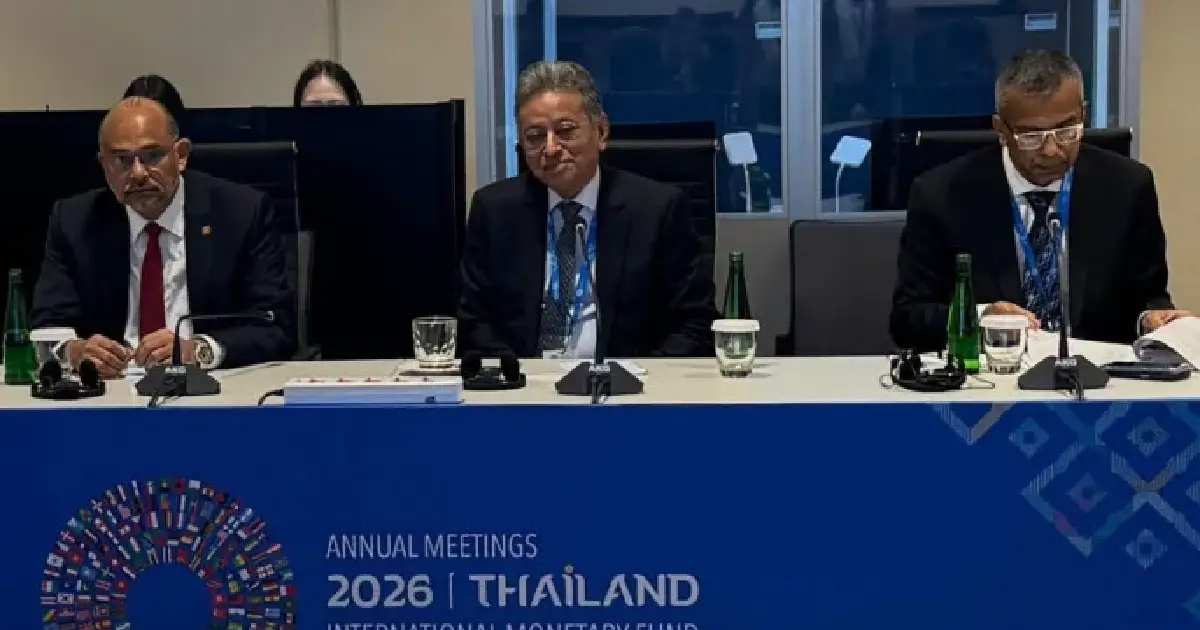
The World Bank supports the Bangladesh government’s policies to address the country’s current economic challenges, restore stability and implement medium- and long-term development plans, Finance Minister Amir Khasru Mahmud Chowdhury said on Tuesday.
He said the global lender was broadly aligned with Bangladesh’s economic programmes and policy priorities and would continue to support the country’s economic recovery and future development.
The finance minister made the remarks while speaking to journalists after a meeting with a World Bank managing director in Bangkok, Thailand, on October 13.
Amir Khasru said Bangladesh’s economy was facing significant challenges when the current government took office. Alongside dealing with the financial and economic burdens inherited from the previous period, the country was also having to navigate global economic disruptions caused by ongoing wars and geopolitical tensions.
He said the World Bank understood the realities facing Bangladesh and supported the government’s policy approach to overcoming the economic difficulties.
“The World Bank is aligned with the programmes and policy direction we have set to restore economic stability and ensure future development,” the minister said, adding that both sides would continue working together.
He said the World Bank was willing and prepared to provide the assistance Bangladesh needed.
No decision yet on proposed $10 billion in additional assistance
Clarifying reports that Bangladesh had sought an additional $10 billion in assistance from the World Bank, the finance minister said no final decision had been made.
He said discussions with the lender were ongoing and that possible proposals would be reviewed in light of those discussions. The process could take several months to complete, he added.
“No decision is being made at this stage. I have seen several inaccurate reports here and there. This is a discussion, and there will be follow-up based on these talks. It is a process that will continue over the next few months,” he said.
The minister stressed that the ongoing discussions should not be interpreted as a final agreement. Rather, they were intended to establish a basis for determining the next steps and considering possible decisions.
Further discussions would also take place in Dhaka, he said.
Expressing satisfaction with the progress of the talks, Amir Khasru said Bangladesh was in a favourable position to establish a framework for future cooperation.
He reiterated that the government’s economic policies, programmes and medium- and long-term development plans were broadly aligned with the World Bank’s position.
Government’s economic agenda aligned with BNP manifesto
The finance minister also said the World Bank’s position was consistent with the government’s economic plans and the Bangladesh Nationalist Party’s (BNP) election manifesto.
He said discussions were underway on how to address the country’s economic challenges and achieve the government’s development objectives.
According to the minister, the government has submitted a written proposal outlining a framework for partnership with the World Bank. Discussions on the proposed framework will continue.
He said the World Bank had provided various recommendations and suggestions, while Bangladesh had also presented its own proposals and recommendations.
Further discussions would be based on these submissions, he added.
Government optimistic about inflation and GDP targets
Asked about forecasts by the World Bank and the Asian Development Bank (ADB) on inflation and gross domestic product (GDP) growth, and how they compared with the government’s targets, the finance minister said the government did not intend to dispute the projections made by other institutions.
He said the institutions had prepared their forecasts based on their own calculations and analyses, adding that the country’s economic performance would become clearer as progress on key indicators was assessed over time.
“We do not want to dispute anyone’s projections. They have made their estimates based on their own calculations. We are carrying out our work, and they are doing theirs. What matters most is that the cooperation we need continues,” he said.
The minister expressed optimism that the government would be able to meet the inflation targets set out in the national budget.
He said the government was working to restore economic stability through continued engagement with the World Bank, implementation of its economic policies and progress on medium- and long-term development plans.