Economy
PM Sheikh Hasina seeks UN, other Int. organisations’ cooperation for mayhem probe


Prime Minister Sheikh Hasina today sought cooperation from the United Nations (UN) and other international organisations to conduct a proper investigation into the nationwide mayhem to punish the real culprits involved in the attacks taking advantage of the anti-quota movement.
“We’re seeking UN and other international organisations’ cooperation for fair and proper investigation into the matter. The people involved in the matter have to be exposed to justice,” she said, adding, “Because, I know I have no negligence to this end”.
The premier made the remarks as the chief guest while formally inaugurating a week-long ‘National Fisheries Week-2024’ at Bangabandhu International Conference Centre (BICC) here.
She came down heavily on those who were involved in destruction of the public establishments alongside killing many people and thus tarnishing the country’s image.
“My question is that who has gained what (through the mayhem)? Why were the bloods shed?” she said.
The prime minister said they have already formed a one-member judicial probe commission with an apex court justice prior to raising any such demand to investigate into the matter.
“We have formed the commission with a judge (of the High Court). Today, I have given an order to include two more as manpower and enhance the periphery of the investigation,” she said.
The prime minister once again leaving the charge of exposing the persons involved in the mayhem to justice on the countrymen.
“You (countrymen) have to find out the people involved in the conspiracy to push the country backward through fishing in troubled water by launching such an incident,” she said.
The conspiracies being hatched by the collaborators of the Pakistani occupation forces pushed Bangladesh back time and again, she added.
“These are the most painful and regrettable things,” she said with an emotional voice.
The prime minister also honoured 22 people and organisations with the National Fisheries Medal in recognition of their outstanding contribution to the country’s fisheries sector.
At the function, she conferred them with the medals -six gold medals, eight silver medals and eight bronze medals- and certificates.
The 22 medal recipients include 15 farm owners, two fisheries officers, a project director, a university teacher, an association leader, a project and a committee.
She, as well, handed over smart ID cards among the two registered fishermen.
The prime minister is also awarded a gold medal for her significant contribution to the fisheries.
Fisheries and Livestock Minister Md Abdur Rahman and its Secretary Sayeed Mahmood Belal Haider, spoke on the occasion.
Director General (DG) of Department of Fisheries Syed Md. Alamgir conducted the award distribution function.
An audio-visual documentary on the progress and success of the government in the fisheries sector was also screened.
This year, the theme of the fisheries week is “Nirapad Machee Varbo Desh, Garbo Smart Bangladesh”.
The National Fisheries Week-2024 will continue till August 5.
Sheikh Hasina said a massive destruction of establishments alongside deaths of many people have taken place in the name of anti-quota movement.
But, the fact was that there was no issue to go for movement as the government had earlier met their all demands including their main demand of quota reform, she said.
“It was a matter of great regret,” she added.
The prime minister said her government had earlier issued a notification cancelling the quota system.
As the High Court scrapped the government notification restoring the quota system, she said her government had filed an appeal against the order with the apex court.
The non-quota system was revived again as the Appellate Division gave a status-quo on the High Court order, she said.
“The most regretful thing was to launch such destruction and take lives of many people in the name of movement in spite of having no issue to stage it (the movement),” she added.
The premier said she even did not think that such an incident would take place this time.
Expressing sorrow at the deaths of many people and sympathy to the bereaved family members, she said, “I know the pain of losing closed one as I am living with the pain of losing near and dear ones.”
She continued: “The establishments which were destroyed can be repaired but the lives which were lost can’t come back again.”
The prime minister said she didn’t know the fault, because of what; such a massive mayhem was launched across the country and thus tarnished the image of Bangladesh internationally.
She said, “To me, power is not a thing to enjoy. I am not coming to power to live a lavish life. I am doing hard works at days and night to make Bangladesh developed. And I have done it successfully.”
The prime minister said she tried her best for changing the fate of the countrymen with giving them an improved life, freeing Bangladesh from poverty, giving houses to homeless and landless and reaching education and healthcare services to every doorstep alongside ensuring food and nutrition security.
She said Bangladesh has reached a dignified position on the global stage with getting the status of a developing country.
Bangladesh is now considered as the model of development due to her government’s tireless efforts, she opined.
“Why has the image of Bangladesh been tarnished? I am giving the responsibility of bringing those involved in the mayhem to justice on the countrymen,” she said.
The prime minister said attempts on her life were made time and again since she returned to the country in 1981 with an aim to change the fate of the distressed people.
“I don’t care for my life rather I dedicated myself to the welfare of the country and its people,” she said.Sheikh Hasina has invited the private sectors to invest in extracting fishes from the deep sea.
“We will extend all cooperation required for the private sectors to this end,” she said.
The prime minister asked all concerned to maintain due standard in processing the fishes and add value to those to enhance their exports.
Recalling the remarks made by the Father of the Nation that fisheries would be the second highest earning source of Bangladesh, she said her government has taken various measures for the development of the sector giving topmost priority.
She said they have already taken measures so that the farmers can get fair prices of the fishes.



The International Monetary Fund (IMF) has urged Bangladesh to maintain a tight monetary policy to contain inflation, while stressing that monetary tightening alone will not be enough to restore economic stability.
Inflation in Bangladesh rose to 8 per cent in September, according to the IMF. The Washington-based lender has called for broader reforms in the financial sector, stronger revenue mobilisation and improvements in overall economic management to address the country’s persistent economic challenges.
Sonali Jain-Chandra, deputy director of the IMF’s Asia and Pacific Department, made the remarks in response to a question at a news conference on the economic outlook for Asia and the Pacific, held on the sidelines of the IMF and World Bank Group annual meetings in Bangkok, Thailand.
Asked whether tight monetary policy alone would be sufficient to tackle inflationary pressures that have persisted for more than three and a half years, Jain-Chandra said maintaining a restrictive monetary stance was important, but needed to be accompanied by other reforms.
Bangladesh is currently facing challenges in three key areas: revenue mobilisation, the financial sector and inflation, she said.
The IMF also expressed concern over the fragile state of Bangladesh’s financial sector, saying a credible reform strategy was needed to strengthen the sector’s capacity and ensure stability.
The fund also highlighted the country’s persistently weak revenue collection. Bangladesh’s tax-to-GDP ratio has declined over time and currently stands at around 7 per cent, placing it among the lowest in the world, according to the IMF.
The IMF stressed the need for a coordinated effort to increase revenue collection, saying higher government revenues were essential to finance development expenditure and strengthen the financial sector.
It called for necessary reforms to the revenue system and effective measures to improve the government’s capacity to generate income.
Talks Under Way on New IMF Programme
Meanwhile, discussions are continuing on a potential new lending programme for Bangladesh.
Jain-Chandra said Bangladeshi authorities approached the IMF in May for support under a new programme after deciding not to draw further instalments under the previous arrangement.
In response to the request, an IMF mission visited Dhaka in July to discuss various aspects of Bangladesh’s economic reform agenda.
According to Jain-Chandra, the reform issues discussed during the visit were closely aligned with the recommendations outlined in the IMF’s Article IV consultation for Bangladesh earlier this year.
The IMF has remained in regular contact with Bangladeshi authorities since the July visit, she said.
Jain-Chandra added that the fund remained closely engaged with the authorities and was ready to support Bangladesh in initiating the reforms needed to address its economic challenges.
The International Monetary Fund (IMF) has projected that Bangladesh’s gross domestic product (GDP) will grow by 3.2 per cent in the 2026-27 fiscal year, while average inflation could rise to 10.9 per cent, signalling mounting pressure on the country’s economy.
The projections were outlined in the IMF’s World Economic Outlook (WEO) report, released on Tuesday.
The latest growth forecast marks a significant downward revision from the 4.3 per cent projected by the IMF in April. The fund had subsequently forecast growth of 3.5 per cent in July before lowering its estimate further to 3.2 per cent.
The IMF has also sharply revised its inflation outlook for Bangladesh. In April, it projected average inflation of 6 per cent for the 2026-27 fiscal year. The latest estimate raises that figure to 10.9 per cent.
The combination of slower economic growth and persistently high inflation points to continued pressure on Bangladesh’s macroeconomic stability.
Bangladesh growth outlook trails other forecasts
The IMF’s latest growth projection for Bangladesh is lower than those of other major international development institutions.
The World Bank has forecast GDP growth of 3.4 per cent for Bangladesh in the 2026-27 fiscal year, while the Asian Development Bank (ADB) has projected growth of 4 per cent.
According to the IMF, Bangladesh’s economy grew by 3.6 per cent in the 2025-26 fiscal year, following growth of 3.5 per cent in the preceding fiscal year.
India, Bhutan expected to grow faster
The IMF has projected stronger economic growth in neighbouring countries, with India’s economy expected to expand by 7 per cent and Bhutan’s by 6.9 per cent in the relevant fiscal year.
The contrasting forecasts highlight the challenges facing Bangladesh as it seeks to restore economic momentum while tackling persistent inflation.
The IMF’s latest projections come as the annual meetings of the IMF and the World Bank Group are underway in Bangkok, Thailand.
Bangladesh’s economic situation, reform programmes and efforts to secure financing from development partners are among the key issues receiving attention during the meetings.
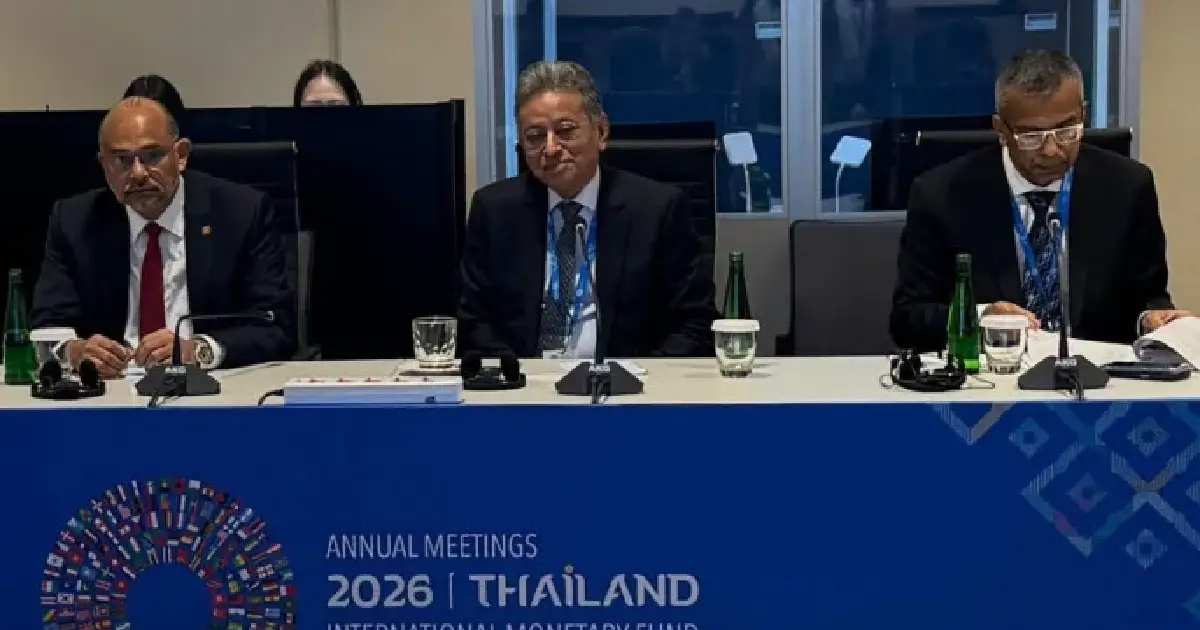
The World Bank supports the Bangladesh government’s policies to address the country’s current economic challenges, restore stability and implement medium- and long-term development plans, Finance Minister Amir Khasru Mahmud Chowdhury said on Tuesday.
He said the global lender was broadly aligned with Bangladesh’s economic programmes and policy priorities and would continue to support the country’s economic recovery and future development.
The finance minister made the remarks while speaking to journalists after a meeting with a World Bank managing director in Bangkok, Thailand, on October 13.
Amir Khasru said Bangladesh’s economy was facing significant challenges when the current government took office. Alongside dealing with the financial and economic burdens inherited from the previous period, the country was also having to navigate global economic disruptions caused by ongoing wars and geopolitical tensions.
He said the World Bank understood the realities facing Bangladesh and supported the government’s policy approach to overcoming the economic difficulties.
“The World Bank is aligned with the programmes and policy direction we have set to restore economic stability and ensure future development,” the minister said, adding that both sides would continue working together.
He said the World Bank was willing and prepared to provide the assistance Bangladesh needed.
No decision yet on proposed $10 billion in additional assistance
Clarifying reports that Bangladesh had sought an additional $10 billion in assistance from the World Bank, the finance minister said no final decision had been made.
He said discussions with the lender were ongoing and that possible proposals would be reviewed in light of those discussions. The process could take several months to complete, he added.
“No decision is being made at this stage. I have seen several inaccurate reports here and there. This is a discussion, and there will be follow-up based on these talks. It is a process that will continue over the next few months,” he said.
The minister stressed that the ongoing discussions should not be interpreted as a final agreement. Rather, they were intended to establish a basis for determining the next steps and considering possible decisions.
Further discussions would also take place in Dhaka, he said.
Expressing satisfaction with the progress of the talks, Amir Khasru said Bangladesh was in a favourable position to establish a framework for future cooperation.
He reiterated that the government’s economic policies, programmes and medium- and long-term development plans were broadly aligned with the World Bank’s position.
Government’s economic agenda aligned with BNP manifesto
The finance minister also said the World Bank’s position was consistent with the government’s economic plans and the Bangladesh Nationalist Party’s (BNP) election manifesto.
He said discussions were underway on how to address the country’s economic challenges and achieve the government’s development objectives.
According to the minister, the government has submitted a written proposal outlining a framework for partnership with the World Bank. Discussions on the proposed framework will continue.
He said the World Bank had provided various recommendations and suggestions, while Bangladesh had also presented its own proposals and recommendations.
Further discussions would be based on these submissions, he added.
Government optimistic about inflation and GDP targets
Asked about forecasts by the World Bank and the Asian Development Bank (ADB) on inflation and gross domestic product (GDP) growth, and how they compared with the government’s targets, the finance minister said the government did not intend to dispute the projections made by other institutions.
He said the institutions had prepared their forecasts based on their own calculations and analyses, adding that the country’s economic performance would become clearer as progress on key indicators was assessed over time.
“We do not want to dispute anyone’s projections. They have made their estimates based on their own calculations. We are carrying out our work, and they are doing theirs. What matters most is that the cooperation we need continues,” he said.
The minister expressed optimism that the government would be able to meet the inflation targets set out in the national budget.
He said the government was working to restore economic stability through continued engagement with the World Bank, implementation of its economic policies and progress on medium- and long-term development plans.