Economy
Engage with ‘new Bangladesh’ that aims to realise freedom, democracy: Dr Yunus urges global leaders at UNGA


Chief Adviser Prof Muhammad Yunus today (27 September) called upon the international community to engage with ‘new Bangladesh’ that aims to realise freedom and democracy for everyone.
The call came in Yunus’ address to the 79th session of the United Nations General Assembly (UNGA), his first since a student-led upsurge brought him at the helm of Bangladesh’s interim government last month.
Speaking in Bangla the Nobel Peace Laureate said youth in Bangladesh have shown upholding freedom, dignity and rights of people regardless of distinction and status cannot just remain aspirational. “It is just what everyone deserves.”
“I would, therefore, call on the international community to continue and deepen engagements with Bangladesh in meeting our people’s quest for democracy, rule of law, equality, prosperity, so that we can emerge as a just and inclusive democratic society,” he said.
Prof Yunus said international cooperation should create space for developing countries in ways that can bring transformative applications or solutions for jobs, endemic socio-economic challenges, or livelihoods.
“We need newer forms of collaboration where global business and knowledge-holders connect to people’s needs,” he said.
“In this assembly of nations, Bangladesh would assure that we would and continue to deliver our bit, at international, regional and national levels, in securing peace, prosperity and justice, for everyone,” said the chief adviser.
As this great hall reverberates with crying call for peace, security, justice, inclusivity and equitable distribution of wealth, as states, he said they need to reflect on how they embolden men and women today, create space for them to grow as entrepreneurs tomorrow.
The world has more than enough of capacity, resources and solutions. Let us redeem all the pledges we made, nationally or internationally, Prof Yunus said.
“Let us work together to end all forms of inequality and discrimination, within and among nations, especially in advancing the proposition of social business in our economic interactions,” said the chief adviser.
In the beginning of his speech, Prof Yunus expressed deep appreciation to Secretary-General Antonio Guterres, for his unwavering commitment to deliver on the UN mandates and address the global challenges.
“I particularly applaud his vision in convening the Summit of the Future,” he said, noting that the Pact for the Future and the Declaration on Future Generations could help in setting pathways beyond Agenda 2030.
Bangladesh believes that the summit’s outcome will serve as a guiding framework in materializing our shared aspirations and re-thinking collaboration, for posterity.
“I stand in this parliament of nations thanks to an epochal transformation that Bangladesh witnessed this July and August. The ‘power of the ordinary people’, in particular our youth, presented to our nation an opportunity to overhaul many of our systems and institutions,” Prof Yunus said.
The uprising led by the students and youth was initially aimed at ending discrimination.
“Progressively the movement evolved into a people’s movement. The world eventually saw how people at large stood against autocracy, oppression, discrimination, injustice and corruption, both on the streets and online,” said Prof Yunus.
He said people, particularly youth, gained their independence from an autocratic and undemocratic regime with their exceptional resolve and capability.
“That collective resolve should define Bangladesh of the future and place our nation as a responsive and responsible state in the comity of nations,” he said.
This was indeed a movement that primarily brought together people who were long left in politics and development.
“Who asked ‘prosperity’ to be shared, to be inclusive. The people aspired for a just, inclusive and functioning democracy for which our new generations made supreme sacrifice.”
Prof Yunus said they were moved by the wisdom, courage and conviction the youth showed.
“Even braving bullets, bare chest. Young girls were fiercely vocal against the illegitimate state power. School-going teenagers laid down their lives,” Prof Yunus said.
Hundreds lost their eyes, forever. Mothers, day labourers and scores of people across cities lent their shoulders, for “their children”.
“Defying sweat, rain and fear of death, they defeated all the evil designs and machinations of the few who manipulated the state machinery against truth and just aspirations of people for years,” Prof Yunus said.
The people’s movement left an estimated over eight hundred martyrs in the hands of the autocratic regime, he said.
“Bangladesh was born because of her people’s profound belief in liberalism, pluralism, secularism. Decades later, our ‘Generation Z’ is making us re-visit and re-imagine the very values that our people Bangladesh stood for back in 1971. As our people also did in 1952, to defend our mother language, Bangla,” Prof Yunus said.
He said they believe, the ‘monsoon revolution’ that the world witnessed in Bangladesh in the span of few weeks, may inspire many across communities and countries, to stand for freedom and justice, he mentioned.
Prof Yunus said their youth and people together entrusted him and his colleagues in the Council with enormous responsibilities to re-construct a decaying state apparatus.
“As we took to the office, to our utter shock and dismay, we discovered how endemic corruption a ‘functioning democracy’ was brought to farce, how key institutions were ruthlessly politicised, how public coffers were reduced to rubble, how oligarchs took over business, how ‘chosen few’ concentrated wealth in their hands and amassed and laundered wealth out of Bangladesh,” he described.
In all, justice, ethics and morality, almost at every level, reached a low, said the chief adviser.
Under such circumstances, he said, they were asked to rebuild Bangladesh and give back the country to the people. “To correct the ills of the past as also build a competitive and agile economy, and a just society.”
In a drastically changed scenario, all political parties are now free to voice their views and opinions, he said.
“A key priority for us is also to make all in public positions and institutions to account for their decisions and actions,” said Prof Yunus.
He said they are committed to promote and protect fundamental rights – for people to speak in freedom, to assemble without fear or inhibition, to vote whosoever they choose, to uphold the independence of the judiciary and freedom of the press, including in the cyber domain.
“In order to ensure that child of a farmer or worker can scale the highest in the society, we prioritise allocation in education and health sectors over grandiose infrastructure development,” he said.
The interim government also aims at ensuring good governance, across all sectors.
Prof Yunus assured that their government shall adhere to all international, regional and bilateral instruments that Bangladesh is party to. “Bangladesh will continue to remain an active proponent of multilateralism, with the UN at the core.”
Bangladesh is open to nurture friendly relations with all countries based on mutual respect, upholding “our dignity and pride and shared interests”, he reiterated.
In just seven weeks, the government has initiated several actions.
At interim government’s request, UN high commissioner for Human Rights has dispatched a Fact-Finding Mission to investigate the gross human rights violations during the people’s movement and to suggest sustainable course correction.
That mission has already started work on the ground in Bangladesh.
“I wish to register my deep appreciation to High Commissioner Volker Turk,” Prof Yunus said.
The government has acceded to the International Convention for Protection of All Persons from Enforced Disappearance, within two weeks in office.
“The required national legislation is underway so that we can effectuate its early implementation. An Inquiry Commission has started investigating into all the cases of enforced disappearances reported during the past decade and a half,” Prof Yunus said.
In order to restore people’s trust and confidence, and to ensure that the tragic past never recur in future Bangladesh, the government has initiated reforms in certain prioritised sectors.
In that direction, the government launched independent Commissions to reform electoral system, constitution, judicial system, civil administration, law and order sectors.
A few more commissions are on the cards to reform other sectors, including press and media, he said.
To create a conducive environment for business, the government has rolled out extensive reforms in banking and financial sectors.
“We affirm not to let any foreign business interest to be affected,” Prof Yunus said.
Beyond rhetoric and numbers, he said they aim to establish effective safeguard mechanisms to ensure the sustainability of these reforms and create an enabling environment towards conduct of free, fair and participatory elections.



The International Monetary Fund (IMF) has urged Bangladesh to maintain a tight monetary policy to contain inflation, while stressing that monetary tightening alone will not be enough to restore economic stability.
Inflation in Bangladesh rose to 8 per cent in September, according to the IMF. The Washington-based lender has called for broader reforms in the financial sector, stronger revenue mobilisation and improvements in overall economic management to address the country’s persistent economic challenges.
Sonali Jain-Chandra, deputy director of the IMF’s Asia and Pacific Department, made the remarks in response to a question at a news conference on the economic outlook for Asia and the Pacific, held on the sidelines of the IMF and World Bank Group annual meetings in Bangkok, Thailand.
Asked whether tight monetary policy alone would be sufficient to tackle inflationary pressures that have persisted for more than three and a half years, Jain-Chandra said maintaining a restrictive monetary stance was important, but needed to be accompanied by other reforms.
Bangladesh is currently facing challenges in three key areas: revenue mobilisation, the financial sector and inflation, she said.
The IMF also expressed concern over the fragile state of Bangladesh’s financial sector, saying a credible reform strategy was needed to strengthen the sector’s capacity and ensure stability.
The fund also highlighted the country’s persistently weak revenue collection. Bangladesh’s tax-to-GDP ratio has declined over time and currently stands at around 7 per cent, placing it among the lowest in the world, according to the IMF.
The IMF stressed the need for a coordinated effort to increase revenue collection, saying higher government revenues were essential to finance development expenditure and strengthen the financial sector.
It called for necessary reforms to the revenue system and effective measures to improve the government’s capacity to generate income.
Talks Under Way on New IMF Programme
Meanwhile, discussions are continuing on a potential new lending programme for Bangladesh.
Jain-Chandra said Bangladeshi authorities approached the IMF in May for support under a new programme after deciding not to draw further instalments under the previous arrangement.
In response to the request, an IMF mission visited Dhaka in July to discuss various aspects of Bangladesh’s economic reform agenda.
According to Jain-Chandra, the reform issues discussed during the visit were closely aligned with the recommendations outlined in the IMF’s Article IV consultation for Bangladesh earlier this year.
The IMF has remained in regular contact with Bangladeshi authorities since the July visit, she said.
Jain-Chandra added that the fund remained closely engaged with the authorities and was ready to support Bangladesh in initiating the reforms needed to address its economic challenges.
The International Monetary Fund (IMF) has projected that Bangladesh’s gross domestic product (GDP) will grow by 3.2 per cent in the 2026-27 fiscal year, while average inflation could rise to 10.9 per cent, signalling mounting pressure on the country’s economy.
The projections were outlined in the IMF’s World Economic Outlook (WEO) report, released on Tuesday.
The latest growth forecast marks a significant downward revision from the 4.3 per cent projected by the IMF in April. The fund had subsequently forecast growth of 3.5 per cent in July before lowering its estimate further to 3.2 per cent.
The IMF has also sharply revised its inflation outlook for Bangladesh. In April, it projected average inflation of 6 per cent for the 2026-27 fiscal year. The latest estimate raises that figure to 10.9 per cent.
The combination of slower economic growth and persistently high inflation points to continued pressure on Bangladesh’s macroeconomic stability.
Bangladesh growth outlook trails other forecasts
The IMF’s latest growth projection for Bangladesh is lower than those of other major international development institutions.
The World Bank has forecast GDP growth of 3.4 per cent for Bangladesh in the 2026-27 fiscal year, while the Asian Development Bank (ADB) has projected growth of 4 per cent.
According to the IMF, Bangladesh’s economy grew by 3.6 per cent in the 2025-26 fiscal year, following growth of 3.5 per cent in the preceding fiscal year.
India, Bhutan expected to grow faster
The IMF has projected stronger economic growth in neighbouring countries, with India’s economy expected to expand by 7 per cent and Bhutan’s by 6.9 per cent in the relevant fiscal year.
The contrasting forecasts highlight the challenges facing Bangladesh as it seeks to restore economic momentum while tackling persistent inflation.
The IMF’s latest projections come as the annual meetings of the IMF and the World Bank Group are underway in Bangkok, Thailand.
Bangladesh’s economic situation, reform programmes and efforts to secure financing from development partners are among the key issues receiving attention during the meetings.
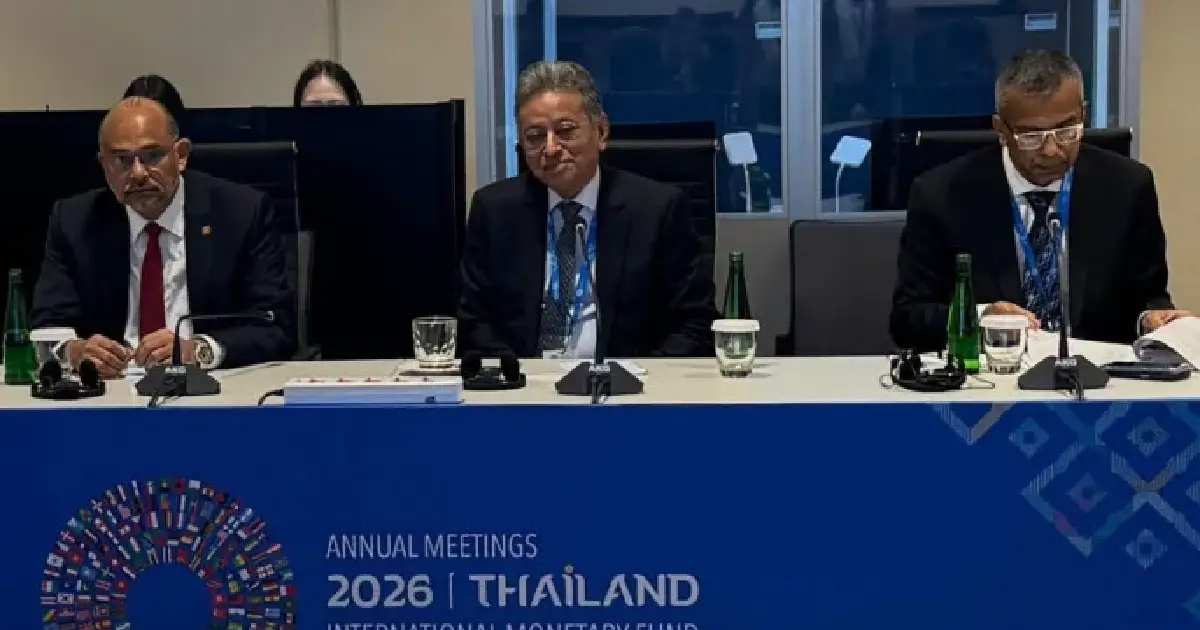
The World Bank supports the Bangladesh government’s policies to address the country’s current economic challenges, restore stability and implement medium- and long-term development plans, Finance Minister Amir Khasru Mahmud Chowdhury said on Tuesday.
He said the global lender was broadly aligned with Bangladesh’s economic programmes and policy priorities and would continue to support the country’s economic recovery and future development.
The finance minister made the remarks while speaking to journalists after a meeting with a World Bank managing director in Bangkok, Thailand, on October 13.
Amir Khasru said Bangladesh’s economy was facing significant challenges when the current government took office. Alongside dealing with the financial and economic burdens inherited from the previous period, the country was also having to navigate global economic disruptions caused by ongoing wars and geopolitical tensions.
He said the World Bank understood the realities facing Bangladesh and supported the government’s policy approach to overcoming the economic difficulties.
“The World Bank is aligned with the programmes and policy direction we have set to restore economic stability and ensure future development,” the minister said, adding that both sides would continue working together.
He said the World Bank was willing and prepared to provide the assistance Bangladesh needed.
No decision yet on proposed $10 billion in additional assistance
Clarifying reports that Bangladesh had sought an additional $10 billion in assistance from the World Bank, the finance minister said no final decision had been made.
He said discussions with the lender were ongoing and that possible proposals would be reviewed in light of those discussions. The process could take several months to complete, he added.
“No decision is being made at this stage. I have seen several inaccurate reports here and there. This is a discussion, and there will be follow-up based on these talks. It is a process that will continue over the next few months,” he said.
The minister stressed that the ongoing discussions should not be interpreted as a final agreement. Rather, they were intended to establish a basis for determining the next steps and considering possible decisions.
Further discussions would also take place in Dhaka, he said.
Expressing satisfaction with the progress of the talks, Amir Khasru said Bangladesh was in a favourable position to establish a framework for future cooperation.
He reiterated that the government’s economic policies, programmes and medium- and long-term development plans were broadly aligned with the World Bank’s position.
Government’s economic agenda aligned with BNP manifesto
The finance minister also said the World Bank’s position was consistent with the government’s economic plans and the Bangladesh Nationalist Party’s (BNP) election manifesto.
He said discussions were underway on how to address the country’s economic challenges and achieve the government’s development objectives.
According to the minister, the government has submitted a written proposal outlining a framework for partnership with the World Bank. Discussions on the proposed framework will continue.
He said the World Bank had provided various recommendations and suggestions, while Bangladesh had also presented its own proposals and recommendations.
Further discussions would be based on these submissions, he added.
Government optimistic about inflation and GDP targets
Asked about forecasts by the World Bank and the Asian Development Bank (ADB) on inflation and gross domestic product (GDP) growth, and how they compared with the government’s targets, the finance minister said the government did not intend to dispute the projections made by other institutions.
He said the institutions had prepared their forecasts based on their own calculations and analyses, adding that the country’s economic performance would become clearer as progress on key indicators was assessed over time.
“We do not want to dispute anyone’s projections. They have made their estimates based on their own calculations. We are carrying out our work, and they are doing theirs. What matters most is that the cooperation we need continues,” he said.
The minister expressed optimism that the government would be able to meet the inflation targets set out in the national budget.
He said the government was working to restore economic stability through continued engagement with the World Bank, implementation of its economic policies and progress on medium- and long-term development plans.