Economy
Dhaka, Beijing agree to elevate relations to “comprehensive strategic cooperative partnership”


Bangladesh and China have agreed to elevate the relations to a “comprehensive strategic cooperative partnership” from “strategic partnership”, said a joint statement.
Bangladesh foreign ministry published the 27-point joint statement on its website after Prime Minister Sheikh Hasina wrapped up her three-day bilateral visit to China from June 8 to 10.
The prime minister returned home early hours of today from Chinese capital Beijing.
In the joint statement, the two sides have shared the view that early repatriation is the only way to resolve the issue concerning the displaced people from Myanmar, who have taken shelter in Bangladesh.
“Leaders of the two countries agreed to stay committed to the Five Principles of Peaceful Coexistence, carry forward the long-standing friendship, foster greater synergy between development strategies of the two countries, advance the Belt and Road cooperation, and elevate the bilateral relationship to a comprehensive strategic cooperative partnership,” the statement said.
Bangladesh and China applauded their strategic partnership of cooperation established in 2016 and agreed that the China-Bangladesh relationship has reached a new height.
The two countries decided to take the opportunity of celebrating the 50th anniversary of the establishment of China-Bangladesh diplomatic relations in 2025 to plan together for the future development of bilateral ties and take the China-Bangladesh relationship to another new height.
The joint statement between the People’s Republic of China and The People’s Republic of Bangladesh on the Establishment of Comprehensive Strategic Cooperative Partnership is given below:
1. At the invitation of H.E. Li Qiang, Premier of the State Council of the People’s Republic of China, H.E. Sheikh Hasina, Prime Minister of the People’s Republic of Bangladesh, paid an official visit to China from July 8 to 10, 2024.
During the visit, Prime Minister Sheikh Hasina had a meeting with H.E. Xi Jinping, President of the People’s Republic of China, held talks with Premier Li Qiang, and met with H.E. Wang Huning, Chairman of the National Committee of the Chinese People’s Political Consultative Conference. In a cordial and friendly atmosphere, the two sides had in-depth exchange of views on bilateral relations and international and regional issues of mutual interest, and reached extensive consensus.
2. The Bangladesh side congratulated the Chinese side on the 75th anniversary of the founding of the People’s Republic of China, and applauded China’s historic achievements and transformation in economic and social development in the new era.
Bangladesh lauded China’s efforts to build itself into a great modern socialist country in all respects and advance the great rejuvenation of the Chinese nation on all fronts through the Chinese path to modernization, and expressed sincere wish for China to realize the Chinese dream of national rejuvenation as scheduled.
The Chinese side congratulated the People’s Republic of Bangladesh on holding the election of the 12th National Parliament, and congratulated the Bangladesh Awami League led by Prime Minister Sheikh Hasina on winning the general election.
The Chinese side applauded the achievements of Bangladesh in economic and social development, and expressed continued support for Bangladesh’s graduation from the UN Least Developed Countries (LDC) status in 2026 as scheduled and Bangladesh’s steady progress toward realizing its Vision 2041 of a “Smart Bangladesh.”
3. The two sides applauded their strategic partnership of cooperation established in 2016, and agreed that the China-Bangladesh relationship has reached a new height.
Leaders of the two countries agreed to stay committed to the Five Principles of Peaceful Coexistence, carry forward the long-standing friendship, foster greater synergy between development strategies of the two countries, advance the Belt and Road cooperation, and elevate the bilateral relationship to a comprehensive strategic cooperative partnership.
The two sides decided to take the opportunity of celebrating the 50th anniversary of the establishment of China-Bangladesh diplomatic relations in 2025 to plan together for the future development of bilateral ties and take the China-Bangladesh relationship to another new height.
4. The two sides agreed that China and Bangladesh have been good neighbors and good friends since ancient times, sharing a millennium-old history of friendly exchanges.
Over the past 49 years since the establishment of diplomatic relations, the traditional China-Bangladesh friendship forged by generations of leaders of both countries has grown from strength to strength. The two countries have always respected each other, treated each other as equals, and pursued mutual benefits.
With ever deepening mutual trust, the two countries have achieved fruitful outcomes in their practical cooperation, and kept close collaboration in international and regional affairs, thus setting a fine example of friendship and mutually beneficial cooperation in relations between countries.
5. The two sides reaffirmed their commitment to mutual respect for each other’s sovereignty, independence and territorial integrity, and to mutual understanding and support on issues involving each other’s core interests and major concerns.
The Chinese side firmly supports Bangladesh in maintaining peace and stability, realizing development goals as envisioned under Vision 2041, non-interference in its internal affairs, and independently choosing a development path suited to its national conditions. The two sides stressed that the authority of the U.N. General Assembly Resolution 2758 is beyond question and brooks no challenge.
Bangladesh reiterated its firm commitment to the one-China principle and its position that the Government of the People’s Republic of China represents the whole of China, and Taiwan is part of China, and Bangladesh supports China on issues pertaining to China’s core interests and China’s efforts to safeguard its national sovereignty and territorial integrity.
6. The two sides agreed to maintain the momentum of high-level interactions, and enhance strategic communication and deepen strategic mutual trust through visits, exchange of letters, and meetings on multilateral occasions. Both sides agreed to promote closer exchanges and cooperation at official and people-to-people levels.
Both sides expressed satisfaction at interactions between political parties, especially between the governing parties to exchange views on issues of mutual interests.
7. The Bangladesh side expressed appreciation and thanks for China’s support for Bangladesh’s economic and social development, and applauded the important role played by the Belt and Road Initiative (BRI) in promoting the socio-economic development of the people of Bangladesh.
The Chinese side commended Bangladesh for being the first country in South Asia to join and taking part in the BRI.
The two sides agreed to step up experience sharing on development planning and economic development policies, and further deepen high-quality Belt and Road cooperation under the principle of planning together, building together and benefiting together. The two sides will accelerate existing cooperation projects, continue to expand areas of cooperation and work toward more fruitful outcomes in practical cooperation between the two countries.
The Chinese side supported the Bangladesh side’s plan to implement the Southern Integrated Development Initiatives of Bangladesh, among others, under the framework of the Belt and Road Initiative to help this region achieve balanced and sustainable development.
8. The two sides recognized the completion of the Bangabandhu Sheikh Mujibur Rahman Tunnel under Karnaphuli river, the Modernization of Telecommunication Network Project, Development of ICT Infra-Network for Bangladesh Government Phase-III (Info-Sarker 3) and the Single Point Mooring (SPM) with Double Pipeline Project, and expressed satisfaction with the progress in major bilateral cooperation projects, such as the Padma Bridge Rail Link Project, the Project of Expansion and Strengthening of Power System Network under DPDC Area, the Power Grid Network Strengthening Project under PGCB, the Dhaka-Ashulia Elevated Expressway and the Rajshahi Surface Water Treatment Plant Project.
The two sides agreed to push forward projects such as Expansion of Teletalk’s 4G Mobile Broadband Network up to Union Level, Procurement of New Vessels, Water Supply, Sanitation, Drainage, Solid Waste and Faecal Sludge Management for Small Size Pourashavas (Municipalities) in Bangladesh, and Sewage Collection System under Dasherkandi STP Catchment of Dhaka City.
The Chinese side will encourage Chinese enterprises to take an active part in the construction of subways, metro rail and roads, oil and gas exploration, hospitals and water resources and sewage management projects in Bangladesh in a proper way.
The two sides agreed to advance projects such as the Burn Unit in Chattogram Medical College Hospital, the No. 6 Bangladesh-China Friendship Bridge Renovation, the No. 9 Bangladesh-China Friendship Bridge, and the National Emergency Operation Center in Bangladesh.
The Chinese side expressed readiness to continue providing assistance to Bangladesh to the best of its capacity and positively consider the possibility of building hospitals and bridges and renovating convention centers to support economic and social development of Bangladesh.
The Chinese side will continue to provide support for training programs on human resources development of Bangladesh under the framework of “China Aid,”.
9. The two sides agreed to deepen cooperation in trade, investment and finance, conclude the joint feasibility study on a China-Bangladesh free trade agreement, and launch formal negotiations as soon as possible. China has completed the entry procedures for Bangladesh’s fresh mango exports to China, and welcomes Bangladesh to expand exports of jute, leather, aquatic products and other high-quality special products to China.
The two sides agreed to further strengthen communication on the export of high-quality Bangladeshi agricultural products to China.
The two sides agreed to strengthen cooperation on trade promotion. China welcomes Bangladesh’s participation in the China International Import Expo, the China Import and Export Fair, the China-South Asia Expo and other expos. The two sides discussed future cooperation on trade facilitation, aid, and financing for projects or programmes.
The Bangladesh side expressed its appreciation to China for granting zero-tariff treatment on 98 percent of taxable items to Bangladesh, effective from 1 September 2022. The Chinese side has expressed its support to continue the zero-tariff treatment on 98 percent of taxable items to Bangladesh for a transitional period beyond 2026 when Bangladesh will graduate from LDC status.
The two sides agreed to launch negotiations on upgrading the China-Bangladesh Investment Agreement as soon as possible. The two sides expressed satisfaction with the progress in projects invested by Chinese enterprises in Bangladesh.
The Bangladesh side welcomes more investment from Chinese enterprises in Bangladesh in such areas as economic and industrial parks, oil and gas exploration, new energy, water resources and sewage management, garment and other manufacturing sectors, reiterates Bangladesh’s commitments to protecting the security and legitimate rights and interests of all foreign investments including the Chinese projects and personnel in Bangladesh. The two sides agreed to deepen cooperation in infrastructure and construction projects, including through the PPP model.
The two sides agreed to enhance cooperation in financial regulation, and encouraged increased use of local currency settlement in bilateral trade. The Bangladesh side welcomes Chinese banks to establish branches in Bangladesh, and vice versa.
10. The Chinese side expressed its readiness to support and participate in building “Smart Bangladesh,” promote cooperation between digital and ICT think tanks of the two countries, and explore the joint establishment of a digital innovation lab to carry out digital capacity building.
The two sides agreed to strengthen investment cooperation in the field of digital economy. The Chinese side will support bilateral exchanges on digital economy industries, encourage Chinese software companies to empower Bangladesh’s digital infrastructure development, and explore the establishment of a China-Bangladesh innovation cooperation mechanism in cloud computing, to promote the development of Bangladesh’s digital and ICT industries.
The Chinese side expressed its readiness to carry out cooperation on the “international port for the information industry and digital trade” to promote digitization of bilateral trade. The Bangladesh side applauded and expressed thanks for these initiatives.
11. The two sides agreed to enhance cooperation in such fields as agriculture, meteorology, water management and ecological protection.
Both sides agreed to continue harnessing the China-Bangladesh Joint Agriculture Committee to further explore cooperation in hybrid rice and wheat breeding, planting techniques and agricultural machinery equipment, so as to promote the common development of the two countries in agriculture and food security.
Both sides expressed their willingness to further strengthen cooperation in the fields of hydrological forecasting, river dredging, integrated management of water resources, and flood and drought prevention.
Appreciating Bangladesh’s efforts in combating the adverse effect of climate change, the Chinese side reaffirmed its commitment to continuing cooperation with Bangladesh both at bilateral and international levels.
The two sides will leverage the BRI International Green Development Coalition and other platforms to deepen exchanges and cooperation in the fields of pollution prevention and control, and ecological protection, in order to promote green and low-carbon development together. Both sides agreed to enhance cooperation in meteorological disaster prevention and reduction to jointly implement the U.N. “Early Warnings for All” initiative.
12. The two sides agreed to strengthen exchanges and cooperation in health, encourage medical institutions of both countries to deepen practical cooperation in such fields as prevention and treatment of infectious diseases, diagnosis and treatment of chronic diseases, and digitization of health services, and promoting technical exchanges in the research and development of pharmaceuticals, vaccines and medical devices.
13. The two sides recognized the important role of educational exchanges and cooperation in promoting understanding and friendship between the two countries, and agreed to advance exchanges between students, teachers and researchers at various levels, encourage educational institutions of the two sides to carry out cooperative research and joint training, and pursue practical cooperation in the fields of higher, vocational and digital education and Bangla and Chinese language teaching.
The two sides will support universities of China and Bangladesh in co-building Confucius Institutes, encourage educational institutions of the two countries to set up majors and courses on the Chinese and Bangla languages, and support each other in cultivating high-level language talents. The two sides agreed to establish a Luban Workshop in Bangladesh.
14. The two sides agreed to deepen people-to-people exchanges and cooperation, and designate the year of 2025 as the “China-Bangladesh Year of People-to-People Exchanges” to promote interactions between the two countries in the fields of culture, tourism, media, think tanks, sports, youth, women, and persons with disabilities.
The two sides will encourage stronger exchange and experience sharing between artists of the two countries in fine arts, music, dance, theater and movies.
The two sides will support each other in holding promotion activities for cultural and tourism exchange, and strengthen communication, coordination and practical cooperation on tourism policies.
The two sides will further enhance exchanges and cooperation in broadcasting, television and online audiovisual services, and support policy dialogue, broadcasting of each other’s programs, personnel exchanges and technical cooperation.
The two sides encouraged their sports organizations to bolster contact and maintain communication and coordination in international sports affairs.
The two sides will advance women exchanges and interactions, and actively cooperate on training in the areas of women’s empowerment and economic partnership.
The two sides will strengthen cooperation related to persons with disabilities, focusing on personnel training and technical exchanges in such areas as rehabilitation, employment and sports for persons with disabilities, to promote shared progress in actions concerning persons with disabilities.
The two sides support the Center for China Studies in fully playing its role, and support exchanges and dialogue between think tanks and scholars of the two sides.
The two sides agreed to deepen cooperation at the subnational level, and encourage creating more pairs of sister cities.
15. The two sides agreed to step up maritime and blue economy cooperation in areas of marine observation, disaster prevention and mitigation, the Ocean to Climate Seamless Forecasting System (OSF) and the Marine Hazards Early Warning and Mitigation System, with a view to enhancing marine sustainability and resilience of Bangladesh. China will assist Bangladesh to cultivate more talents in marine affairs. The two sides agreed to hold the second round of maritime cooperation dialogue at an early date.
16. Both China and Bangladesh are important representatives of Asian civilizations, and play an indispensable role in protecting the cultural heritage of Asia. The two sides will actively expand exchanges and cooperation on the research and protection of tangible and intangible cultural heritage.
The Chinese side highly commended Bangladesh for joining the Alliance for Cultural Heritage in Asia as an observer country, and looks forward to seeing Bangladesh become a member country at an early date, so that the two sides can, under the framework of the Asian Initiative for Cultural Heritage Conservation, strengthen exchanges and cooperation in the fields of ancient civilization research, joint archaeological exploration, repair of historical sites, and exchanges between museums.
17. The two sides discussed various aspects of the Global Development Initiative put forward by President Xi Jinping. The Chinese side is ready to share experience on GDI issues with the Bangladesh side. The Chinese side also presented the Global Security Initiative (GSI) and the Global Civilization Initiative (GCI) to the Bangladesh side to ensure peace, development and shared prosperity for all.
18. On defense cooperation, the two sides agreed to strengthen more exchanges at all levels and between various armed forces and departments, and deepen practical cooperation in defense. Both sides agreed to maintain their mutual understanding and engagement on UN peacekeeping and peace building issues.
19. The two sides agreed to strengthen coordination in international and multilateral affairs, and expressed readiness to further coordinate positions and build broader consensus in multilateral processes concerning international peace and security, sustainable development, human rights, humanitarian affairs, climate change, energy transition and environmental protection, to jointly safeguard the common interest of developing countries.
20. Bearing in mind that this year marks the 70th anniversary of the Five Principles of Peaceful Coexistence, the two sides agreed on the need to carry forward the Five Principles of mutual respect for sovereignty and territorial integrity, mutual non-aggression, mutual non-interference in each other’s internal affairs, equality and mutual benefit, and peaceful coexistence, with a view to jointly building a community with a shared future for Asia and for mankind.
The two sides agreed to firmly safeguard the international system with the UN at its core, the international order underpinned by international law, and the basic norms governing international relations based on the purposes and principles of the UN Charter, uphold true multilateralism together, promote greater democracy in international relations, and work to foster an equal and orderly multipolar world and a universally beneficial and inclusive economic globalization.
21. The two sides agreed to further strengthen coordination and collaboration in multilateral organizations and mechanisms such as the United Nations, World Trade Organization and ASEAN Regional Forum.
The Chinese side welcomes Bangladesh’s bid for BRICS membership and interest in associating with SCO.
The Bangladesh side expressed appreciation for China’s efforts to successfully establish the “International Day for Dialogue among Civilizations” and its important role in promoting mutual understanding and respect among civilizations, cultures and religions.
The Chinese side congratulated Bangladesh on the 25th anniversary of its flagship Resolution on a “Culture of Peace,” first mooted by Prime Minister Sheikh Hasina in 1999.
22. The two sides reiterated that the fundamental way out of the ongoing grave crisis in Gaza lies in the implementation of the two-State solution and the establishment of an independent State of Palestine.
Relevant resolutions adopted by the U.N. Security Council are binding and should be enforced effectively to achieve immediate, unconditional and lasting ceasefire. The two sides called on the international community to address the question of Palestine with a greater sense of urgency, and step-up efforts to facilitate resumption of peace talks and achieve enduring peace.
23. The two sides share the view that the promotion and protection of human rights is a common cause of all humanity, and the rights to subsistence and development are basic human rights of paramount importance.
The two sides support exchanges and cooperation on human rights among all countries on the basis of equality and mutual respect, advocate the common values of humanity, oppose politicization of human rights, and remain committed to jointly promoting sound progress in all aspects of the international human rights agenda.
24. The two sides share the view that early repatriation is the only way to resolve the issue concerning the displaced people from Rakhine State of Myanmar, who have taken shelter in Bangladesh.
The two sides call on all parties in Myanmar to bridge their differences through dialogue and consultation and underscored the cessation of hostilities in Rakhine State as soon as possible.
The Bangladesh side expressed its appreciation to and requested China to continue playing a constructive role to facilitate dialogue for the peaceful settlement of the issue concerning the displaced people from Rakhine State.
The Chinese side commended efforts made over the years by Bangladesh to provide humanitarian assistance for the displaced people, and expressed support for Bangladesh and Myanmar to find a mutually acceptable solution through friendly consultations and following the arrangements on repatriation existing between the countries.
China will continue to provide support for this purpose to the best of its abilities, including providing a platform for dialogue to help achieve early repatriation of the displaced people.
25. The two sides share the view that climate change is a global challenge. It is imperative for all countries to work together within the framework of multilateralism and in accordance with the principles of equity, common but differentiated responsibilities and respective capabilities, to advance the full and effective implementation of the United Nations Framework Convention on Climate Change and its Paris Agreement.
26. During the visit, the two sides signed cooperation documents on trade and investment, digital economy, financial regulation, education cooperation, medical care and public health, infrastructure cooperation, green and low carbon development, agricultural cooperation, hydrological forecasting, and cooperation in radio and television.
27. Prime Minister Sheikh Hasina expressed her sincere appreciation to the government and people of the People’s Republic of China for the friendship and warm hospitality extended to her and the Bangladesh delegation, and invited Chinese leaders to visit Bangladesh.
The Chinese leaders thanked Prime Minister Sheikh Hasina for the invitation, and the two sides will maintain communication via diplomatic channels.



The International Monetary Fund (IMF) has urged Bangladesh to maintain a tight monetary policy to contain inflation, while stressing that monetary tightening alone will not be enough to restore economic stability.
Inflation in Bangladesh rose to 8 per cent in September, according to the IMF. The Washington-based lender has called for broader reforms in the financial sector, stronger revenue mobilisation and improvements in overall economic management to address the country’s persistent economic challenges.
Sonali Jain-Chandra, deputy director of the IMF’s Asia and Pacific Department, made the remarks in response to a question at a news conference on the economic outlook for Asia and the Pacific, held on the sidelines of the IMF and World Bank Group annual meetings in Bangkok, Thailand.
Asked whether tight monetary policy alone would be sufficient to tackle inflationary pressures that have persisted for more than three and a half years, Jain-Chandra said maintaining a restrictive monetary stance was important, but needed to be accompanied by other reforms.
Bangladesh is currently facing challenges in three key areas: revenue mobilisation, the financial sector and inflation, she said.
The IMF also expressed concern over the fragile state of Bangladesh’s financial sector, saying a credible reform strategy was needed to strengthen the sector’s capacity and ensure stability.
The fund also highlighted the country’s persistently weak revenue collection. Bangladesh’s tax-to-GDP ratio has declined over time and currently stands at around 7 per cent, placing it among the lowest in the world, according to the IMF.
The IMF stressed the need for a coordinated effort to increase revenue collection, saying higher government revenues were essential to finance development expenditure and strengthen the financial sector.
It called for necessary reforms to the revenue system and effective measures to improve the government’s capacity to generate income.
Talks Under Way on New IMF Programme
Meanwhile, discussions are continuing on a potential new lending programme for Bangladesh.
Jain-Chandra said Bangladeshi authorities approached the IMF in May for support under a new programme after deciding not to draw further instalments under the previous arrangement.
In response to the request, an IMF mission visited Dhaka in July to discuss various aspects of Bangladesh’s economic reform agenda.
According to Jain-Chandra, the reform issues discussed during the visit were closely aligned with the recommendations outlined in the IMF’s Article IV consultation for Bangladesh earlier this year.
The IMF has remained in regular contact with Bangladeshi authorities since the July visit, she said.
Jain-Chandra added that the fund remained closely engaged with the authorities and was ready to support Bangladesh in initiating the reforms needed to address its economic challenges.
The International Monetary Fund (IMF) has projected that Bangladesh’s gross domestic product (GDP) will grow by 3.2 per cent in the 2026-27 fiscal year, while average inflation could rise to 10.9 per cent, signalling mounting pressure on the country’s economy.
The projections were outlined in the IMF’s World Economic Outlook (WEO) report, released on Tuesday.
The latest growth forecast marks a significant downward revision from the 4.3 per cent projected by the IMF in April. The fund had subsequently forecast growth of 3.5 per cent in July before lowering its estimate further to 3.2 per cent.
The IMF has also sharply revised its inflation outlook for Bangladesh. In April, it projected average inflation of 6 per cent for the 2026-27 fiscal year. The latest estimate raises that figure to 10.9 per cent.
The combination of slower economic growth and persistently high inflation points to continued pressure on Bangladesh’s macroeconomic stability.
Bangladesh growth outlook trails other forecasts
The IMF’s latest growth projection for Bangladesh is lower than those of other major international development institutions.
The World Bank has forecast GDP growth of 3.4 per cent for Bangladesh in the 2026-27 fiscal year, while the Asian Development Bank (ADB) has projected growth of 4 per cent.
According to the IMF, Bangladesh’s economy grew by 3.6 per cent in the 2025-26 fiscal year, following growth of 3.5 per cent in the preceding fiscal year.
India, Bhutan expected to grow faster
The IMF has projected stronger economic growth in neighbouring countries, with India’s economy expected to expand by 7 per cent and Bhutan’s by 6.9 per cent in the relevant fiscal year.
The contrasting forecasts highlight the challenges facing Bangladesh as it seeks to restore economic momentum while tackling persistent inflation.
The IMF’s latest projections come as the annual meetings of the IMF and the World Bank Group are underway in Bangkok, Thailand.
Bangladesh’s economic situation, reform programmes and efforts to secure financing from development partners are among the key issues receiving attention during the meetings.
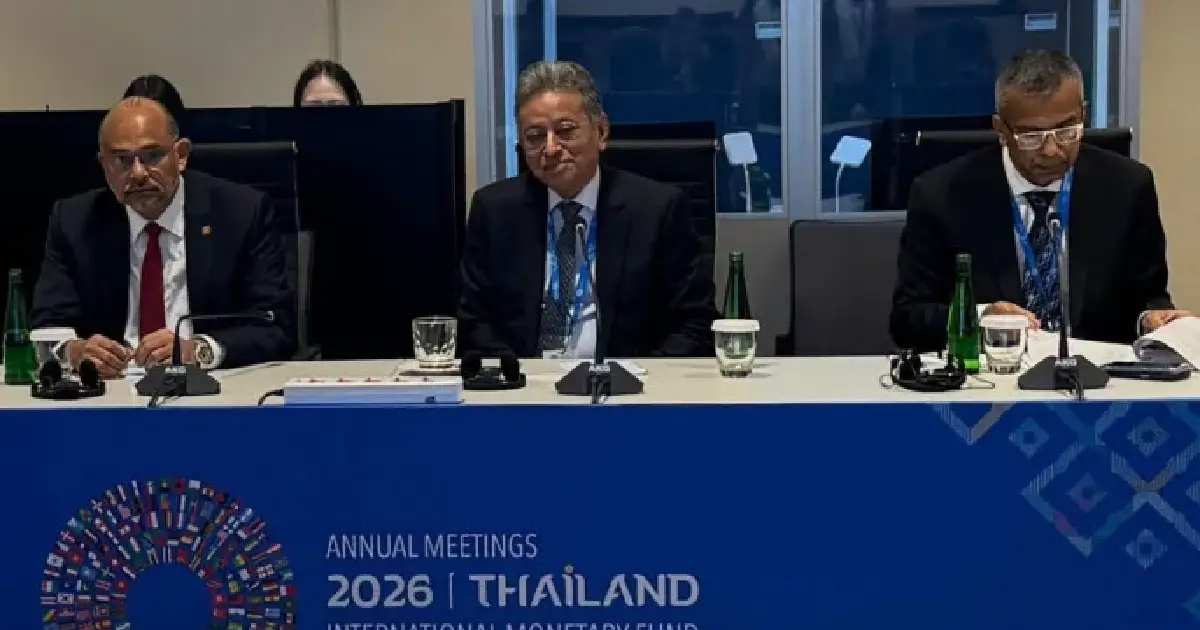
The World Bank supports the Bangladesh government’s policies to address the country’s current economic challenges, restore stability and implement medium- and long-term development plans, Finance Minister Amir Khasru Mahmud Chowdhury said on Tuesday.
He said the global lender was broadly aligned with Bangladesh’s economic programmes and policy priorities and would continue to support the country’s economic recovery and future development.
The finance minister made the remarks while speaking to journalists after a meeting with a World Bank managing director in Bangkok, Thailand, on October 13.
Amir Khasru said Bangladesh’s economy was facing significant challenges when the current government took office. Alongside dealing with the financial and economic burdens inherited from the previous period, the country was also having to navigate global economic disruptions caused by ongoing wars and geopolitical tensions.
He said the World Bank understood the realities facing Bangladesh and supported the government’s policy approach to overcoming the economic difficulties.
“The World Bank is aligned with the programmes and policy direction we have set to restore economic stability and ensure future development,” the minister said, adding that both sides would continue working together.
He said the World Bank was willing and prepared to provide the assistance Bangladesh needed.
No decision yet on proposed $10 billion in additional assistance
Clarifying reports that Bangladesh had sought an additional $10 billion in assistance from the World Bank, the finance minister said no final decision had been made.
He said discussions with the lender were ongoing and that possible proposals would be reviewed in light of those discussions. The process could take several months to complete, he added.
“No decision is being made at this stage. I have seen several inaccurate reports here and there. This is a discussion, and there will be follow-up based on these talks. It is a process that will continue over the next few months,” he said.
The minister stressed that the ongoing discussions should not be interpreted as a final agreement. Rather, they were intended to establish a basis for determining the next steps and considering possible decisions.
Further discussions would also take place in Dhaka, he said.
Expressing satisfaction with the progress of the talks, Amir Khasru said Bangladesh was in a favourable position to establish a framework for future cooperation.
He reiterated that the government’s economic policies, programmes and medium- and long-term development plans were broadly aligned with the World Bank’s position.
Government’s economic agenda aligned with BNP manifesto
The finance minister also said the World Bank’s position was consistent with the government’s economic plans and the Bangladesh Nationalist Party’s (BNP) election manifesto.
He said discussions were underway on how to address the country’s economic challenges and achieve the government’s development objectives.
According to the minister, the government has submitted a written proposal outlining a framework for partnership with the World Bank. Discussions on the proposed framework will continue.
He said the World Bank had provided various recommendations and suggestions, while Bangladesh had also presented its own proposals and recommendations.
Further discussions would be based on these submissions, he added.
Government optimistic about inflation and GDP targets
Asked about forecasts by the World Bank and the Asian Development Bank (ADB) on inflation and gross domestic product (GDP) growth, and how they compared with the government’s targets, the finance minister said the government did not intend to dispute the projections made by other institutions.
He said the institutions had prepared their forecasts based on their own calculations and analyses, adding that the country’s economic performance would become clearer as progress on key indicators was assessed over time.
“We do not want to dispute anyone’s projections. They have made their estimates based on their own calculations. We are carrying out our work, and they are doing theirs. What matters most is that the cooperation we need continues,” he said.
The minister expressed optimism that the government would be able to meet the inflation targets set out in the national budget.
He said the government was working to restore economic stability through continued engagement with the World Bank, implementation of its economic policies and progress on medium- and long-term development plans.