Economy
COP27: BD to reiterate for $100b pledged for developing nations


Global leaders are progressing for the COP27 next month, November — to take action towards achieving collective climate goals set under Paris Agreement and the Convention.
The 27th Conference of the Parties to the UN Framework Convention on Climate Change, or ‘COP27’, will build on the outcomes of COP26 to deliver action on an array of issues critical to tackling the climate emergency.
These actions are: urgently reducing greenhouse gas emissions, building resilience and adapting to the inevitable impacts of climate change, and delivering on the commitments to finance climate action in developing countries.
Bangladesh will reiterate its call to materialize the pledge of providing $100 billion funds per year to developing nations at the most prior, authorities stated.
Bangladesh will also highlight the importance of “enhanced funds” for climate change mitigation and adaptation at the conference that will take place from November 6 to 18 in Sharm el-Sheikh, Egypt.
Nations are expected to demonstrate at COP27 that they are in a new era of implementation by turning their commitments under the Paris Agreement into action.
Heads of state and governments will attend the Sharm el-Sheikh Climate Implementation Summit on November 7 and 8 while a high-level segment primarily attended by ministers will take place from November 15-18.
The Vulnerable 20 (V20) and Group of 7 (G7) will jointly launch the Global Shield Against Climate Risks at COP27 in a wider effort to accelerate pre-arranged financing at speed and scale.
The V20 membership stands at 58 economies representing some 1.5 billion people including Bangladesh.
The Vulnerable 20 Group of Finance Ministers from climate-vulnerable economies and the G7 Presidency have already revealed they have reached an agreement on financial protection cooperation that responds to loss and damage as a contribution to the Paris Climate Treaty.
Foreign Minister AK Abdul Momen has called for the implementation of climate financing pledges commensurate with the principles of loss and damage ahead of the climate conference going to take place in Sharm El Sheikh next month.
State Minister for Planning Dr. Shamsul Alam has said Bangladesh firmly believes that climate change is a security issue and it must be discussed at regular intervals at the United Nations Security Council (UNSC).
Bangladesh has been a significant player in global climate diplomacy and during the presidency of CVF, Bangladesh emerged as a bold voice in the climate change negotiations under the leadership of Prime Minister Sheikh Hasina.
Bangladesh has launched the “Mujib Climate Prosperity Plan” with the aim to put her on a journey from climate vulnerability to resilience to climate prosperity. The government sees it as one of the landmark policy guidelines for climate-vulnerable countries.
As government representatives start to finalize the agenda for the COP27 climate change conference in Egypt next month, the UN chief told journalists in New York that the work ahead is “as immense as the climate impacts we are seeing around the world”.
“At COP27, I will launch an action plan to provide early warning systems for all within five years,” said UN Secretary-General Antonio Guterres. He seeks the governments, international financial institutions and civil society to support it.
“We came out of Paris, COP21, with a historic agreement which set out a framework of what needs to be done, and then in Glasgow previous year, an agreement on how to do it,” said Simon Stiell, the sixth Executive Secretary of the UN Framework Convention on Climate Change (UNFCCC) or UN Climate Change.
2022 marks seven years since the adoption of the Paris Agreement on Climate Change – a landmark international treaty to tackle the climate crisis.
The agreement calls for limiting global warming to well below 2°C above pre-industrial levels and pursuing efforts to limit it to 1.5°C. To get there, the world needs to halve its carbon emissions by 2030.



The International Monetary Fund (IMF) has urged Bangladesh to maintain a tight monetary policy to contain inflation, while stressing that monetary tightening alone will not be enough to restore economic stability.
Inflation in Bangladesh rose to 8 per cent in September, according to the IMF. The Washington-based lender has called for broader reforms in the financial sector, stronger revenue mobilisation and improvements in overall economic management to address the country’s persistent economic challenges.
Sonali Jain-Chandra, deputy director of the IMF’s Asia and Pacific Department, made the remarks in response to a question at a news conference on the economic outlook for Asia and the Pacific, held on the sidelines of the IMF and World Bank Group annual meetings in Bangkok, Thailand.
Asked whether tight monetary policy alone would be sufficient to tackle inflationary pressures that have persisted for more than three and a half years, Jain-Chandra said maintaining a restrictive monetary stance was important, but needed to be accompanied by other reforms.
Bangladesh is currently facing challenges in three key areas: revenue mobilisation, the financial sector and inflation, she said.
The IMF also expressed concern over the fragile state of Bangladesh’s financial sector, saying a credible reform strategy was needed to strengthen the sector’s capacity and ensure stability.
The fund also highlighted the country’s persistently weak revenue collection. Bangladesh’s tax-to-GDP ratio has declined over time and currently stands at around 7 per cent, placing it among the lowest in the world, according to the IMF.
The IMF stressed the need for a coordinated effort to increase revenue collection, saying higher government revenues were essential to finance development expenditure and strengthen the financial sector.
It called for necessary reforms to the revenue system and effective measures to improve the government’s capacity to generate income.
Talks Under Way on New IMF Programme
Meanwhile, discussions are continuing on a potential new lending programme for Bangladesh.
Jain-Chandra said Bangladeshi authorities approached the IMF in May for support under a new programme after deciding not to draw further instalments under the previous arrangement.
In response to the request, an IMF mission visited Dhaka in July to discuss various aspects of Bangladesh’s economic reform agenda.
According to Jain-Chandra, the reform issues discussed during the visit were closely aligned with the recommendations outlined in the IMF’s Article IV consultation for Bangladesh earlier this year.
The IMF has remained in regular contact with Bangladeshi authorities since the July visit, she said.
Jain-Chandra added that the fund remained closely engaged with the authorities and was ready to support Bangladesh in initiating the reforms needed to address its economic challenges.
The International Monetary Fund (IMF) has projected that Bangladesh’s gross domestic product (GDP) will grow by 3.2 per cent in the 2026-27 fiscal year, while average inflation could rise to 10.9 per cent, signalling mounting pressure on the country’s economy.
The projections were outlined in the IMF’s World Economic Outlook (WEO) report, released on Tuesday.
The latest growth forecast marks a significant downward revision from the 4.3 per cent projected by the IMF in April. The fund had subsequently forecast growth of 3.5 per cent in July before lowering its estimate further to 3.2 per cent.
The IMF has also sharply revised its inflation outlook for Bangladesh. In April, it projected average inflation of 6 per cent for the 2026-27 fiscal year. The latest estimate raises that figure to 10.9 per cent.
The combination of slower economic growth and persistently high inflation points to continued pressure on Bangladesh’s macroeconomic stability.
Bangladesh growth outlook trails other forecasts
The IMF’s latest growth projection for Bangladesh is lower than those of other major international development institutions.
The World Bank has forecast GDP growth of 3.4 per cent for Bangladesh in the 2026-27 fiscal year, while the Asian Development Bank (ADB) has projected growth of 4 per cent.
According to the IMF, Bangladesh’s economy grew by 3.6 per cent in the 2025-26 fiscal year, following growth of 3.5 per cent in the preceding fiscal year.
India, Bhutan expected to grow faster
The IMF has projected stronger economic growth in neighbouring countries, with India’s economy expected to expand by 7 per cent and Bhutan’s by 6.9 per cent in the relevant fiscal year.
The contrasting forecasts highlight the challenges facing Bangladesh as it seeks to restore economic momentum while tackling persistent inflation.
The IMF’s latest projections come as the annual meetings of the IMF and the World Bank Group are underway in Bangkok, Thailand.
Bangladesh’s economic situation, reform programmes and efforts to secure financing from development partners are among the key issues receiving attention during the meetings.
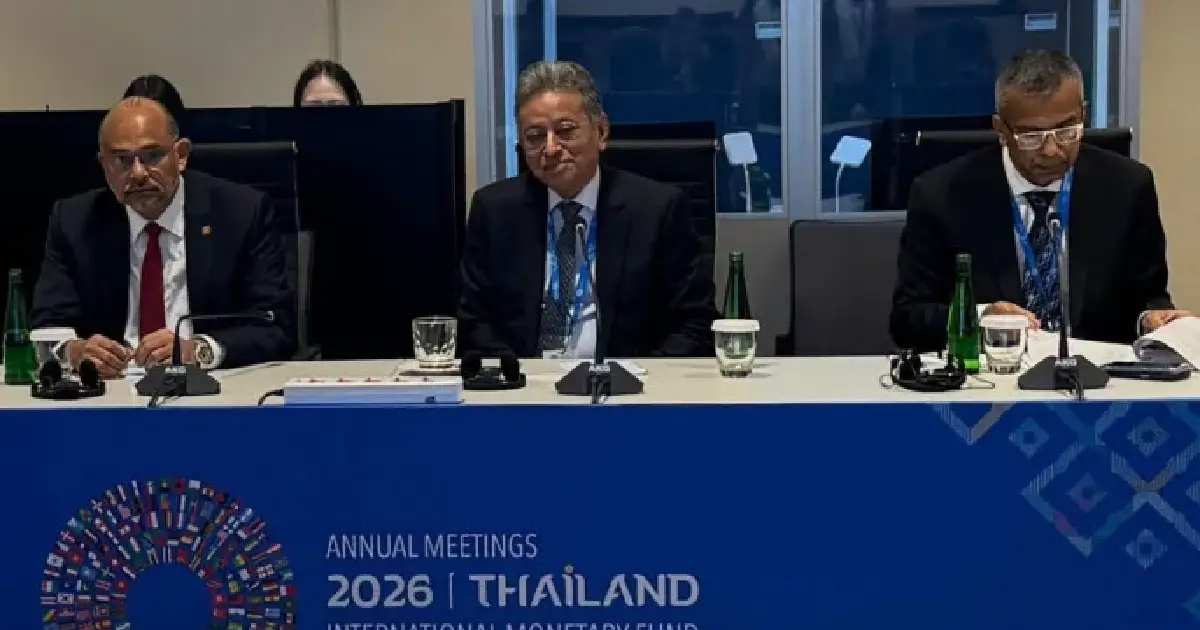
The World Bank supports the Bangladesh government’s policies to address the country’s current economic challenges, restore stability and implement medium- and long-term development plans, Finance Minister Amir Khasru Mahmud Chowdhury said on Tuesday.
He said the global lender was broadly aligned with Bangladesh’s economic programmes and policy priorities and would continue to support the country’s economic recovery and future development.
The finance minister made the remarks while speaking to journalists after a meeting with a World Bank managing director in Bangkok, Thailand, on October 13.
Amir Khasru said Bangladesh’s economy was facing significant challenges when the current government took office. Alongside dealing with the financial and economic burdens inherited from the previous period, the country was also having to navigate global economic disruptions caused by ongoing wars and geopolitical tensions.
He said the World Bank understood the realities facing Bangladesh and supported the government’s policy approach to overcoming the economic difficulties.
“The World Bank is aligned with the programmes and policy direction we have set to restore economic stability and ensure future development,” the minister said, adding that both sides would continue working together.
He said the World Bank was willing and prepared to provide the assistance Bangladesh needed.
No decision yet on proposed $10 billion in additional assistance
Clarifying reports that Bangladesh had sought an additional $10 billion in assistance from the World Bank, the finance minister said no final decision had been made.
He said discussions with the lender were ongoing and that possible proposals would be reviewed in light of those discussions. The process could take several months to complete, he added.
“No decision is being made at this stage. I have seen several inaccurate reports here and there. This is a discussion, and there will be follow-up based on these talks. It is a process that will continue over the next few months,” he said.
The minister stressed that the ongoing discussions should not be interpreted as a final agreement. Rather, they were intended to establish a basis for determining the next steps and considering possible decisions.
Further discussions would also take place in Dhaka, he said.
Expressing satisfaction with the progress of the talks, Amir Khasru said Bangladesh was in a favourable position to establish a framework for future cooperation.
He reiterated that the government’s economic policies, programmes and medium- and long-term development plans were broadly aligned with the World Bank’s position.
Government’s economic agenda aligned with BNP manifesto
The finance minister also said the World Bank’s position was consistent with the government’s economic plans and the Bangladesh Nationalist Party’s (BNP) election manifesto.
He said discussions were underway on how to address the country’s economic challenges and achieve the government’s development objectives.
According to the minister, the government has submitted a written proposal outlining a framework for partnership with the World Bank. Discussions on the proposed framework will continue.
He said the World Bank had provided various recommendations and suggestions, while Bangladesh had also presented its own proposals and recommendations.
Further discussions would be based on these submissions, he added.
Government optimistic about inflation and GDP targets
Asked about forecasts by the World Bank and the Asian Development Bank (ADB) on inflation and gross domestic product (GDP) growth, and how they compared with the government’s targets, the finance minister said the government did not intend to dispute the projections made by other institutions.
He said the institutions had prepared their forecasts based on their own calculations and analyses, adding that the country’s economic performance would become clearer as progress on key indicators was assessed over time.
“We do not want to dispute anyone’s projections. They have made their estimates based on their own calculations. We are carrying out our work, and they are doing theirs. What matters most is that the cooperation we need continues,” he said.
The minister expressed optimism that the government would be able to meet the inflation targets set out in the national budget.
He said the government was working to restore economic stability through continued engagement with the World Bank, implementation of its economic policies and progress on medium- and long-term development plans.


You must be logged in to post a comment Login